More Fun With Sentence Templates

Photo Courtesy of Wikimedia Commons

Last week, I recommended creating a template for each long sentence in your writing to help you determine whether the sentence is impressive or simply incomprehensible. You may recall that a sentence template looks something like this: 

By doing x, we can accomplish y and z.

Filling in the blanks with elements other than the words “doing,” “accomplish,” and the letters “x,” “y,” and “z,” we get something like the following sentences: 

  1. By observing migration patterns over a period of three years, we can predict the return date of the loons with reasonable accuracy and prepare emergency bird sanctuaries to care for any birds who were injured in flight.
  2. By teaching young children to recognize and appreciate a healthy diet, teachers and parents can help members of the next generation enjoy a high quality of life and avoid contracting a host of nutrition-related illnesses.

As you can see, this particular sentence template is useful across a range of contexts. I could spend a good deal of time making up sentences to fit the “by doing x, we can accomplish y and z” pattern. Indeed, I have been known to spend a good deal of time creating and filling in sentence templates, and I urge you to do the same. Specifically, I urge you to keep what I call a Vocabulary and Syntax Journal. Here’s how it works: 

STEP ONE: Buy or make a small notebook – 5 x 7 is a great size. If you’re a student enrolled in multiple classes, you may want to keep one Vocabulary and Syntax Journal for each of your classes.

STEP TWO: Label the notebook with the year, the semester, or the name of the class for which you are keeping the journal.

STEP THREE: Once per week, when you read for fun or for your class, keep the journal beside you. Plan to make between three and five entries in your journal each week. What should you choose for your entries? Maybe you’ll choose between three and five vocabulary items that are new to you. Or maybe you’ll choose to make sentence templates of three to five sentences that are particularly elegant or well-structured and that you would like to use in your own writing. Or maybe you’ll choose a combination of vocabulary and sentence templates, aka syntax. Whatever you do, don’t choose more than five items in any given week: it’s inefficient to overload your brain with too many new vocabulary and syntax items!

STEP FOUR: When you write your own papers, keep your Vocabulary and Syntax Journal with you. Incorporate at least one new vocabulary item and one new sentence structure into each text you write. Soon, you’ll be writing like a pro in your academic courses or professional endeavors!

HINT: The Vocabulary and Syntax Journal is also a huge help if you’re learning a foreign language.

Happy Writing and Happy Journaling!

Dr. Lori 

The Long Sentence: Impressive? Or Incomprehensible?

Photo from Wikimedia Commons

The texts that we read offer all sorts of clues about what to do—and what not to do—when writing our own texts. Published texts contain every lesson that a new writer needs, from demonstrating how to incorporate and cite others’ ideas to modeling the use of language and style. Over the next few weeks, I’ll help you identify and take advantage of each of the lessons that can be learned simply by reading texts in the disciplines you study. Today, I’ll start with a seemingly small lesson that nonetheless makes a big impact: sentence length and structure. 

New writers often assume that flamboyantly long sentences are a requirement in academic writing. Indeed, sentence length does get a bit out of control in some (most? all?) academic texts. To that end, new writers often get into the habit of piling as many words as possible into a sentence, hoping to impress the reader, dazzle the instructor, and earn a high grade. But I warn you to tread cautiously when packing word after word after word into a single sentence. Be careful to distinguish between impressively long sentences and incomprehensibly long sentences. The following two examples illustrate the concept of impressively long sentences:

SENTENCE ONE

“By analyzing the kinds of grammatical choices that help students successfully accomplish assigned tasks, we can reveal the overt and covert expectations that guide the assessment and evaluation of students’ school performance and identify the choices that are highly valued in academic language tasks” (Schleppegrell, 2004, p. 4). [44 words]

Schleppegrell, M. (2004). The Language of Schooling: A Functional Linguistics Perspective. Mahwah, New Jersey: Lawrence Erlbaum Associates. 

SENTENCE TWO

“The Jahrestage (Anniversaries) of Uwe Johnson (1934-84), begun in 1968 and completed in 1983, have a complex narrative structure and strongly subjective perspective, but the realistic intention of this major post-war novel, set between August 1967 and August 1968, with many flashbacks to the Nazi and early GDR past, is unquestionable” (McGowan, 2000, p. 489). [51 words]

McGowan, M. (2000) “German writing in the West (1945-1990),” in H. Watanabe-O’Kelly (Ed.), The Cambridge History of German Literature, pp 440-506. Cambridge: Cambridge University Press. 

Meanwhile, the following example illustrates the concept of incomprehensibly long sentences: 

SENTENCE THREE

Although the study showed potential, it concluded that the first and second treatment programs offered to the participants were beneficial, with an overwhelming number of positive outcomes, but with minor changes to the timing and duration of the therapy sessions, could improve the treatments. – Invented by me, modeled on sample sentences collected over the years from student writing. [44 words]

So what’s the difference between the impressively long sentences and the incomprehensibly long sentence?, you ask. All three sentences take a while to read, and all three use language that sounds professional or formal. Why are the first two classified as impressive, while the last one is classified as incomprehensible? The difference lies not just in the number of ideas presented in each sentence but also in the relationships between and among those ideas. If we create a template for each sentence, mapping out the number of ideas in each sentence and illustrating the relationships between those ideas, we’d get something like the following: 

Template of ideas and relationships in SENTENCE ONE: 

By doing x, we can accomplish y and z. 

This template contains three ideas: (1) by doing x, (2) we can accomplish y, and (3) we can accomplish z. These three ideas are connected to one another through straightforward cause-and-effect relationships.

Template of ideas and relationships in SENTENCE TWO: 

X piece of literature, which was written between year and year, exhibits quality y, but [insert phrase that identifies the genre of the book, followed by one or more relative clauses that provide additional information relevant to the genre] also exhibits the contrasting quality of z.

This template contains two ideas: (1) x piece of literature exhibits quality y, but (2) x piece of literature also exhibits the contrasting quality of z. These two ideas are connected to one another through a straightforward relationship of tension or contrast. Each idea is supplemented through the use of relative clauses that provide additional information about the piece of literature in question. The relative clauses can be removed without affecting the meaning of the sentence; for this reason, the sentence can be reduced to the following simple template: 

X piece of literature exhibits quality y, but also exhibits the contrasting quality of z. 

Template of ideas and relationships in SENTENCE THREE: 

Positive comment about a study + transition word that introduces a contrast + summary of the topic that does not contrast with the preceding information + another transition word that introduces a contrast + observation that might serve as a contrast to the first idea.

This template contains five ideas: (1) a positive statement about x study, (2) BUT, (3) summary of x study, (4) BUT, and (5) summary of things that could be changed to improve the treatments offered to study participants. None of these ideas is clearly related to the others, although it’s possible that the fifth idea might be related to the first and second ideas. 

The table at the bottom of this post helps to illustrate the relationships between ideas in each sentence. Consider using such a table and templates to map out the ideas in each long sentence that you write. If you are able to create a template that captures straightforward relationships between each idea in your sentence, you’ve got an impressively long sentence: use it and be proud of it! If you are not able to create a template that captures straightforward relationships between each idea in your sentence, you’ve got an incomprehensibly long sentence: revise it, but don’t be ashamed of it! There’s no shame in admitting that you crafted an incomprehensibly long sentence and need to edit it out. After all, it takes a while to get used to writing impressively long sentences. As a way of developing your impressively-long-sentence-writing skills, consider mapping out two or three impressively long sentences from one or more of the texts that you read each week in your courses. Once you begin mapping out the sentences modeled in the texts you read, you’ll begin to develop a feel for the rhythms and relationships of impressively long sentences. Soon, you’ll be able to write your own impressively long sentences without a second thought! 

Happy Reading, Happy Sentence Mapping, Happy Writing, and Happy Long-Sentence-Editing!

Dr. Lori 

Sentence Template, SENTENCE ONE     
 Idea OneIdea TwoIdea Three  
By doing x, we can accomplish y and zBy analyzing the kinds of grammatical choices……we can reveal……and identify…  
       
Sentence Template, SENTENCE TWO     
 Idea OneIdea TwoIdea Three  
X piece of literature exhibits quality y, but also exhibits the contrasting quality of zThe Jahrestage (Anniversaries) of Uwe Johnson…have a complex narrative structure……but this [genre of book], [insert one or more relative clauses which contain information relevant to the genre of book named above], also exhibits the contrasting quality of z.   
       
Sentence Template,
SENTENCE THREE
     
 Idea OneIdea TwoIdea ThreeIdea FourIdea Five
Positive comment about a study + transition word that introduces a contrast + summary of the topic that does not contrast with the preceding information + another transition word that introduces a contrast + observation that might serve as a contrast to the first idea The study showed potential, …but…the study concluded that ……but…treatment could be improved…
      

An Abundance of Scarcity

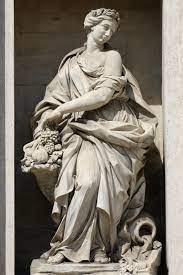
Photo: Detail of the statue of Abundance from Rome’s Trevi Fountain. Photo courtesy of Wikimedia Commons.

Last week, I cryptically noted that the late American comedian George Carlin and the concept of scarcity always come to mind when I ponder the question of why academic writing is so hard. Those of you who have been sitting on the edge of your respective seats, eagerly awaiting an explanation, can relax: said explanation is immediately forthcoming. 

If you’re familiar with George Carlin’s work, you’ll no doubt recognize the line that comes to mind when I think about the difficulty of academic writing. Indeed, the line may have crossed your own mind at some point since last week: 

“It’s a big club, and you ain’t in it.”

While Carlin used this phrase as a way of describing the exclusive in-crowd of well-known federal U.S. politicians, the sentiment can be applied to any institution or cultural practice whose inner workings are carefully guarded from the general public. Such institutions and cultural practices are both grounded in and sustained by the second of those seemingly random concepts that comes to mind when I ponder the question of why academic writing is so hard. That concept, you may recall, is the concept of scarcity. More accurately, that concept is the concept of artificial scarcity. 

Actual scarcity and artificial scarcity play a key role in ensuring that exclusive institutions or cultural practices remain exclusive. Think about diamonds, for example. If diamonds were not so hard to come by (actual scarcity), they would lose much, or perhaps even all, of their perceived value. Or think about Jaguar cars. If Jaguar cars were not so hard to come by (artificial scarcity), they, too, would lose much, or perhaps even all, of their perceived value. For an example of scarcity in the realm of the nonmaterial, think of George Carlin’s U.S. politicians. Think of well-known federal politicians who spend mind-boggling amounts of money on their campaigns, not of an obscure town council person who spent a couple of bucks running off posters at the local copy shop, then biked or walked around the neighborhood with the family and a stapler, attaching said posters to utility poles. If
well-known federal politicians could become well-known federal politicians by simply running off campaign posters and stapling them to utility poles of a Saturday afternoon, well-known federal politicians would almost certainly lose the prestige that holds them squarely in the center of an elite bubble of exclusivity. The largely insurmountable expense of running for federal political office creates an artificial scarcity of opportunity to run for office; in turn, the artificial scarcity of opportunity to run for federal political office ensures that U.S. federal politics remains an exclusive institution. In other words, U.S. federal politics and the well-known players who can afford to act within the realm of politics remain a big club that most of us ain’t in. 

Writing in general, and academic writing in particular, works in much the same way. The secrets of writing are carefully guarded—sometimes intentionally, sometimes not—by the folks who are already in the club of “people who know how to write.” In turn, the artificial scarcity of opportunity to learn the secrets of writing ensures that the group of people who know how to write remains a big club that lots of us ain’t in. 

But things don’t have to be this way. Writing grows from the ideas in a writer’s heart or mind; writing is sparked by the ideas discovered in a book or film or conversation; writing springs forth from the wondrousness of a sunset or the tinyness of a birdsong; writing tiptoes out from the mundaneness of picking up the mail or washing the dishes. These things—ideas, books, conversations, birdsong, the banality of daily life—are by no means scarce. The words used to describe such things are by no means scarce. Nor are the endless permutations of syntax used to string words together scarce. Not one single thing about the act of writing is naturally scarce. 

The artificial scarcity that upholds writing as an elite skillset is another matter, but it’s a matter that can be overcome in small, simple ways. The next time you hear a delightful birdsong, write a poem in your heart. You’ve just become a writer. The next time you go to the store, concoct a story featuring the items on your grocery list. You’ve just become a writer. The next time you post on Facebook or Twitter, you’ve reminded the world that you are a writer. The next time you read, take note of the words you especially love, and take note of the particularly elegant ways in which the writer strings words together. You’ve just given yourself tools to become a better writer. Bit by bit, the artificial scarcity of the writers’ skills vanishes, and you find yourself in, or at least very close to being in, the club. Someday, perhaps, the club will be so large that its secrets remain a secret no more. 

In the meantime, tune in next week, when I’ll let you in on a secret for reading academic articles in ways that directly support you on your journey into the club. 

Happy Writing!

Dr. Lori 

Why is Academic Writing so Hard?

When I ponder the question of why academic writing is so hard, one person and one concept inevitably come to mind. The person is the late American comedian George Carlin. The concept is scarcity.

You’re probably wondering what the late comedian George Carlin has to do with academic writing. You’re probably also wondering what the concept of scarcity has to do with academic writing. And then there’s the question of whether or not George Carlin and the concept of scarcity have anything to do with one another. Or are they simply two unrelated thoughts that somehow—randomly, yet inevitably—come to mind when I think about the question of why academic writing is so hard?

Tune in next week to find out…..

Happy Writing!

Dr. Lori

Text Editing: That’s What it’s All About (aka: Outsmarting Google)

Photo courtesy of pretty much everywhere on the internet since Inauguration Day, 2021. Meme text courtesy of Apple’s Preview software and my mind.

Apparently, the magical computer codes that live inside WordPress, chatting merrily through the cybernight with the magical computer codes that live inside Google, need to be told explicitly what my website is all about. 

To that end, I say: Text editing, text editing, text editing, and more text editing. 

More specically: Academic text editing, academic text editing, academic text editing, and more academic text editing.

But what does “text editing” really mean?

Technically, “text editing” means that an experienced writer polishes a text written by someone else – presumably someone less experienced – to ensure that said text conforms to a set of grammatical, stylistic, and formatting conventions that haven’t yet been fully mastered by the text’s author. 

I can and do do these things as a text editor. I can fix grammatical and formatting errors for you. No problem. I can revise sentences for elegance, clarity, and stylistic consistency. No problem. I can even untangle syntactic snarls for you, unless the snarl is so snarled that I can’t quite figure out what you want to say. In that case, it’s best for me to leave your syntactic snarl alone, lest my attempts to revise change your meaning irrevocably or even just revocably (it’s a word now.) Instead of revising a very tangled sentence in ways that inadvertently change your meaning, I prefer to leave a question in the margin of your paper, asking “do you mean x?” or “do you mean y?” or “can you clarify the relationship between x, y, and z ideas? You present all three ideas in this sentence, but it’s not quite clear how those ideas are related to one another. It might help to present these ideas in two or three separate sentences.” 

In asking questions of this sort, prompting you to clarify both your thoughts and the language used to express them, I take a slightly different approach to text editing than the approach defined above. I aim not only to polish the language and formatting of your text but also to help you grow as a writer, encouraging you to address the “big-picture” or “global” concerns that crop up in everyone’s writing. “Big picture” or “global” concerns are concerns about issues such as the organization of information, the reliability of the evidence used to support your argument, and the quality of the analysis that you offer to explain why and how your evidence supports your argument. Global concerns often overlap with concerns about language and style, which are also known as “local” concerns. As your editor, I tease apart the local and the global, repairing local concerns for you and helping you revise the global concerns not just for the purpose of improving your text but also for the purpose of helping you become a more confident, more persuasive writer in English. 

This, my friends, is what my website is all about. (I hope Google has been paying attention.)

Tune in on January 29th to see how many times I can mention the phrase “academic text editing” in next week’s post….

Happy Writing, Happy Revising, Happy Writing Process-ing, 

Dr. Lori 

A Riddle for Writers

Image of the Sphinx in Egypt from Wikimedia Commons

A Riddle for Writers: 

I am…

the path that leads your reader from point A to point Z and all stops in between
the light that illuminates your argument
the thread that binds your ideas to a cosmic conversation of ideas
the lens that brings your thought processes into focus
the spark of newness that ignites your reader’s interest
the spotlight that showcases your uniqueness
the thing that most often goes missing from a first (and perhaps even a second) draft.

What am I? 

Go forth to ponder! (And note that you may find a hint to the answer in last week’s tip…)

Tune in next week for the answer and a writing tip built around it!

Happy Riddling and Happy Writing, 

Dr. Lori 

The God Who Looked Both Ways

Image of the Roman god Janus from Wikimedia Commons

The month of January was named in honor of the Roman god Janus, the god who looked both ways. While Janus may have been a careful pedestrian, it’s unlikely that he gained his tag line – the god who looked both ways – because of the caution he exercised in crossing the street. Rather, “the god who looked both ways” acknowledges Janus’ propensity for looking both forward and backwards: to the future as well as the past. 

Janus is clearly an appropriate namesake for a month that transitions our western human cultures into a new year, bidding us to learn from the past and joyfully move into the future. But what does this have to do with writing? 

Quite a lot, actually, if you frame it the right way. 

And that’s precisely what this week’s writing tip is about: framing. Not framing, as in “framing a house,” although that meaning of the word could be appropriate, as Janus is often depicted above a doorframe – a transitional space of passage from old to new and back again. Nor is it framing, as in “framing someone for a crime.” This type of framing is inappropriate under any circumstances and should never be done, unless you’re writing a mystery novel!

I’m talking about framing, as in “presenting evidence throughout a piece of writing in a manner that supports, clarifies, or otherwise works with the argument you want to make.” Remember that an argument, to a writer, isn’t about angry people shouting at each other; it’s about making a statement, asserting a claim, or proposing a new idea and helping your reader see why that statement, claim, or idea is worthy of consideration. Framing helps a writer convince the audience that his or her ideas are worthy of consideration. Framing accomplishes this task by demonstrating how the author’s own ideas build upon, challenge, are supported by, or are consistent with the ideas of other authors who have published on the topic. In other words, framing puts the current author’s ideas into a tidy “frame” with other authors’ ideas, so that the relationships between each author’s ideas can be seen, digested, and pondered by the reader. 

During a discussion on the concept of framing in one of my writing classes, a student – let’s call him J – raised his hand tentatively in a room full of tangible silence. He was a shy, soft-spoken student who preferred writing to speaking. It always surprised me when he volunteered a question or comment in class. It surprised me even more that he was the one student bold enough to venture a question or comment in a room full of seemingly shocked people. Encouragingly, I asked him if he had a question. He lowered his hand, nodded, and said “Do you mean that we can use framing to just make stuff up?” 

All of his classmates nodded enthusiastically, murmuring in a mixture of English and the three non-English languages represented in the classroom. The murmuring suggested that everyone in class had been thinking exactly what J had been thinking: the concept of framing is a license to make stuff up, twist the truth, or – at the very least – conceal evidence that is inconvenient to your own argument.

I could see why they would think this. I was also quite glad that they had raised this point, as it provided an excellent opportunity for us to talk about the following: (1) academic dishonesty, (2) the problems of intentionally misrepresenting someone else’s ideas, and (3) the importance of ensuring that your reader understands where the cited author’s ideas end and your interpretation of those ideas begins.

I offered my students the following example as part of our discussion.

Linguist Stephen Krashen’s work on language acquisition is famous for, among many other ideas, the concept of i+1. This concept describes a way for language teachers to use the target language (the language that students are learning) in the classroom. In this formula, the letter “i” stands for input: the language input that students receive by listening to the teacher speak and interacting with the learning materials that the teacher chooses. Meanwhile, “+ 1” refers to the ideal level of complexity or difficulty of the language input to which students are exposed. The formula is a convenient way of saying that language teachers should try to present students with language that is just a little bit – but not too much – more complex than the language that they already know. 

For example, on the first day of my German classes, I like to introduce students to the language right away, by showing them how to introduce themselves in German. Within fifteen minutes, everyone in class has started to figure out a lot of things about the German language: what the personal pronouns for “I,” “you,” “he,” “she,” and “they” sound like; how regular verbs work; and how the cultural conventions of greetings work among speakers of German. Unless students already knew some German before taking my class, they generally can’t explain what they learned from all of the language input I offered them on the first day of class. Nevertheless, they’ve begun to develop a foundation on which to build lots of information about the German language. In other words, they’ve developed a little bit of “i” on which I can build a little bit of “+1.” So the next day, I start class with the same input (“i”) that I used on the first day, introducing myself again and helping students introduce themselves to each other and to me. And then I add the “+1”: I introduce the question “How’s it going?” and model various appropriate answers. And so we work together to build their knowledge of the language slowly but surely with a new “+1” every day. 

Krashen’s concept of “i+1” crops up frequently in scholarly research on language acquisition and language teaching as well as informal conversations among teachers. But it doesn’t always crop up for the same reason. This is how we see the concept of framing in action. I’ve interacted with authors or teachers who interpret the concept of “i+1” to support the argument that students should work with authentic reading materials: texts written for native or proficient readers of the target language. But I’ve also interacted with authors or teachers who interpret the concept of “i+1” to support the argument that students should work with modified texts: texts that have been simplified in some way, or texts that contain translations or notes to help foreign readers make sense of the content without necessarily making sense of the language. 

Proponents of the authentic text argument rarely see eye to eye with proponents of the modified text argument and vice versa. Yet they find a common source of support for their respective arguments in Stephen Krashen’s concept of “i+1.” Neither party misrepresents Krashen’s concept. Rather, each party interprets the pedgagogical benefits of i+1 in a way that is most consistent with his or her own arguments, while acknowledging that other interpretations are possible. 

And this is what framing is all about. It’s about presenting evidence that supports your argument and explaining why you think the evidence supports your argument. If readers disagree with your framing, that’s OK: your framing has opened a door to conversation with the reader. 

In all of this rambling, have you managed to figure out what any of this has to do with the Roman god Janus, the god who looked both directions? Perhaps (almost certainly) you have your own interpretation of the relationship between Janus and the concept of framing. I’ll leave you with my own interpretation: 

Janus looks to both past and future, just as a good writer must look to both past and future. In looking to the past, a writer finds the ideas that inspire, support, or challenge his or her own ideas. In looking to the future, a writer suggests conclusions that can be drawn from or conversations that can flourish about his or her own ideas. In framing, a writer combines past and present, demonstrating how his or her ideas fit into and move the conversation eterally through the universe of ideas. Janus would no doubt approve. 

Tune in next week for more on framing and the art of analysis. 

Happy Writing, and Happy New Year!

Dr. Lori

No Matter How Small

“Who?” – “You.”

“You, who?” – “You, you.”

“Me?” – “Yes, you.”

“Seriously?” – “Seriously.”

“But why?” – “Why not?”

“I’m too young.” – “Doesn’t matter.”

“I don’t have anything to say.” – “I know this isn’t true.”

“I’m not a good writer.” – “No one is a good writer at first.”

“My grammar is bad.” – “Eh, grammar is overrated. Besides, most of the things that people refer to as grammatical ‘errors’ are actually stylistic choices that don’t conform to the expectations of standard writing. With practice, everyone figures out how to make their stylistic choices meet the reader’s expectations. See comment above: ‘no one is a good writer at first.’

“But who wants to read my ideas?.” – “You never know who needs to hear exactly what you’re thinking: who shares your fears, your dreams, your plans, your experiences. It’s true: if you write down your ideas, maybe only one person will read them. But maybe that was one person who really needed to encounter you and your ideas at this particular time and place in the cosmos.”

To all writers who needed to hear this today: take courage and remember that your ideas are valuable and lovely and deserve to be heard. You never know when your ideas will shed a bit of light on someone else’s darkness. Keep writing. No matter how much darkness your own self-doubt may cast, in this, the darkest season of the year, keep bringing points of light – no matter how small – into corners of the word, no matter how small.

If you orbit in a traditional academic world and have a bit of “down time” between semesters, take advantage of the time to scribble and doodle and be creative, writing what you want to write. Take a deep breath and a creative break before jumping back into the work of next semester’s writing.

I’ll be back in two weeks (January 1st) with tips on framing – an appropriate topic as we set a course for the new year!

In the meantime, happy reading, happy writing, happy (hopefully) relaxing,

Dr. Lori

Tell me again why I’m writing this?

Lots of people I know – experienced writers and student writers alike – struggle to write meaningful literature reviews. Many of us don’t seem to be quite sure where we’re going or why we’re going there with a lit review. Many of us, in writing a lit review, have heard questions like the following bouncing around in our brains: 

“Am I writing this lit review to prove that I’ve read the things I’m supposed to have read? If that’s the case, couldn’t I just take a quiz, or something? 

Or am I just writing a lit review because the sample paper I’m using as a model includes a lit review, so I’ve included one in my paper, too? Am I writing it correctly? I can’t really tell because I don’t really know why I’m writing it. It looks more or less the same as the lit review in the sample paper, but I’m not sure it serves the same purpose?”

Allow me to shed a little light on these questions that have surely plagued us all. I’ll begin by reminding you of last week’s tip, in which I reflected on my own journey from reading like a reader to reading like a writer. As part of that journey, I began to recognize that reading can be much more than a simple one-way transmission of information from author to reader. Reading can be, and indeed ideally is, a conversation between author and reader, no matter how much time and geographic distance may lie between them.

This concept of “conversation” is key not just to reading like a writer but to jumpstarting the writing process. Here’s how the jumpstarting works: 

The writer-minded reader reads about something that sounds really cool, like a chatbot that learns from its human interlocutor.

The writer-minded reader wants to know more about chatbots, artificial intelligence, human language learning, and the question of whether or not it’s actually possible for artificial intelligence to “learn” human language at all, let alone from a random human interlocutor. 

And so the writer-minded reader starts reading about psycholinguistics and sociolinguistics and language acquisition and language teaching and artificial intelligence and machine learning and maybe a few other topics as well. 

Somewhere along the way, the writer-minded reader decides that he or she disagrees with the idea that language can be learned by a machine. The writer-minded raeder feels that no algorithms exist (or can exist) to help a machine navigate the cultural, social, emotional, and creative aspects of language use. The writer-minded reader, by expressing disagreement with scholars who feel that machines can learn human language, has now officially entered into conversation with these scholars.

To strengthen his or her position in the conversation, the writer-minded reader dives back into the research, learning more about language and culture and language use and machine learning and all sorts of things. The research that the writer-minded reader explores is slowly morphing into …. [wait for it]

A literature review. 

Yes, that’s right: all of the reading – all of the “conversing with scholars” done by this particular writer-minded reader – turns into a literature review when the writer-minded reader sits down to craft a paper explaining why he or she thinks that artificial intelligence will never be able to “learn” human language. 

You see, the literature review serves as a summary of the ongoing conversation between various experts on the topic that interests you, the writer-minded reader. In a way, then, the lit review does simply serve as a way of proving that you’ve read all the things you’re supposed to have read. But instead of taking a quiz to demonstrate your knowledge, you’ll recap that knowledge for the reader of your paper. You’ll use the things you’ve read to bring your reader up to speed with the conversation, helping him or her understand what has been said before, why the things that have been said are important, and how the things that you will say in your writing continue to build upon the existing conversation. You’ll present your knowledge of the conversation in ways that help the reader understand and enter into your own unique perspective on the conversation. 

This, my friends, is what we call “framing.” No, not framing as in “making someone else take the blame for a misdeed!” I mean framing as in “presenting your knowlede of the conversation in ways that help the reader understand and enter into your own unique perspective on the conversation.” 

Tune in next week for more on framing. In the meantime, rest assured that lit reviews really don’t have to be as intimidating as they often seem. They’re simply a chance for you, the writer-minded reader, to summarize those aspects of an ongoing scholarly conversation that are most important to you, so that you can hop into the conversation with grace, ease, and credibility. 

No problem, right? 

Happy Reading / Happy Writing, 

Dr. Lori 

Nevertheless…

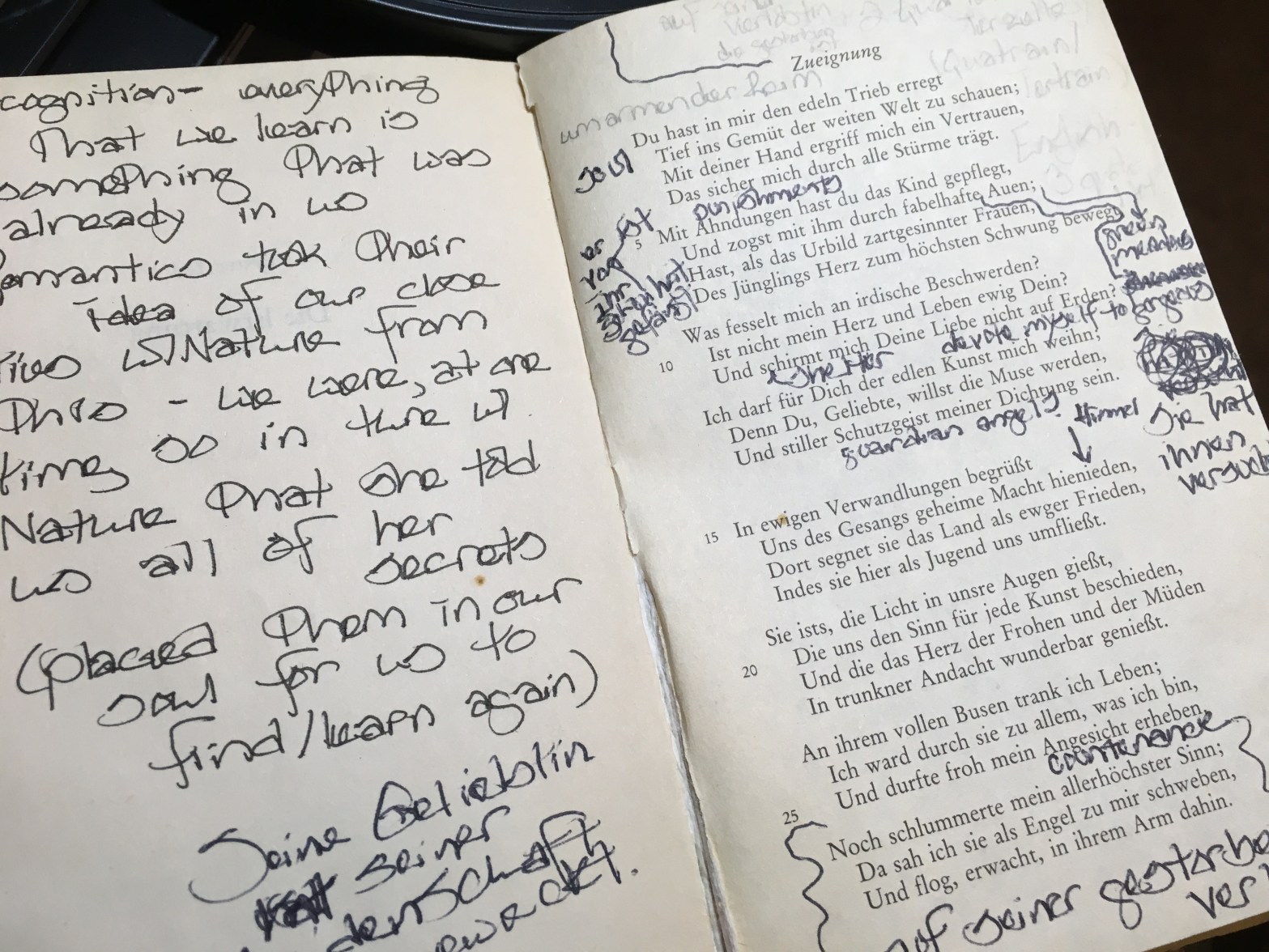
Like most working-class kids of my generation (I suspect), I grew up convinced that writing in a book – even a book that you owned, and even with a pencil – was a crime that ranked pretty close to murder on the scale of awfulness. My beliefs about writing in books may have been influenced by my mother, who worked in a library. Or they may have been influenced by my experience at a small Catholic school, where everyone knew we would use the same set of classroom books for about one thousand years and must, therefore, tiptoe carefully around and through each book, doing everything in our power to preserve it for the next several generations. “Doing everything in our power to preserve” our textbooks for the next several generations included, of course, not writing in the books. 

Naturally, then, I did not write in books. Indeed, I barely interacted with my school books. The textbooks that were assigned to me in high school remained, for most of each year, safely stowed in my locker. I did take each textbook to class with me, placing it neatly on my desk and opening it carefully, if instructed to do so. But that was the extent of my relationship with my high-school textbooks. I don’t recall having taken any of my textbooks home at night, with the exception of my German textbooks. These books were transported respectfully back and forth between the safety of my locker and the precariousness of my desk at home, where they rested dangerously close to the pencil that I used as I practiced grammar and vocabulary exercises on a worksheet from my instructor or a sheet of notepaper. Once, I had been tempted to write in my German One textbook. I had been repeatedly foiled by the word “trotzdem,” whose meaning I could never align with its English equivalent, no matter how hard I tried. Surely, I thought, it would be OK to write the word’s English equivalent in the vocabulary list in the textbook, wouldn’t it? My left hand, with a pencil at the ready, had already begun its descent towards the vocabulary list at the end of the chapter when my moral compass thought better of the whole deal and intervened to stop this small act of book violence. 

After this one brief slip, I managed to make it successfully through the remaining three years of my high school studies without once succumbing to the temptation of writing in a book. 

And then my college studies happened. More specifically, my college studies in a foreign language happened. I was pretty desperate. All of a sudden, my encounters with the German language had gone from memorizing dialogues about musical groups with unlikely names like “The Hot Dogs” and completing worksheets that allowed me to do what I do best – pull sentences apart, ponder their component elements, and stick them together again in new ways – to the terrifying new experience of reading German literature, discussing (in German, and with people whose German was way better than mine) what we had read, and writing papers (in German) in response to what we had read. To make matters worse, the little yellow paperback literature books that filled the shelves of the university bookstore in the GERMAN LITERATURE section were all set in an impossibly tiny font. To round out the nightmare, the first literature course I took presented German literature chronologically, beginning with the baroque period. While German baroque literature is highly commendable, it’s also largely incomprehensible to a 20th-century American student whose knowledge of modern German spelling and vocabulary are barely sufficient to keep up with a simple news report. Holy smokes. 

I immediately abandoned my scruples about book violence and began writing – quite liberally – in my literature books. I really didn’t seem to have a choice. In the intervening 20-odd years, I’ve figured out more effective ways of dealing with an overwhelming amount of new vocabulary and complicated sentence structures, but at the time, writing English equivalents of confusing vocabulary items directly on the page seemed like my only option. Pedagogically questionable as the tactic may have been, it did enable me to survive my literature courses. (If you’re curious: I managed to get an “A,” most likely for effort, in each of my German lit courses. Or perhaps my instructors knew that I, being the type of fleißige Studentin who would keep all of those scribbled-in books and read them years later, after having developed sufficient reading proficiency in my second language, would one day gain at least as much cultural and philosophical insight as I was supposed to have gained in their courses. Indeed, the extra years, life experience, and reading fluency that I possessed by the time I read – really read – those scribbled-in books probably offered me a little more cultural and philosophical insight than my instructors had bargained for when selecting those particular works of literature for inclusion on their course syllabi.)

And so I transformed almost overnight into one of “those people” who write in books. 

My initial book transgression was perhaps forgivable: I desperately needed those translations to keep up with my coursework. Besides, I wrote them in pencil, and I never sold my books back at the end of the semester, two facts that made my crimes against the printed word seem more tolerable. 

But then things got worse. I started writing my translations in pen. 

And then things got even worse. I started making margin notes that had nothing to do with language use or the need to translate. I’d jot down ideas or information that had come up in class discussion. I’d pose questions about historical context or seeming inconsistencies in the plot or obscure symbolism. I’d draw arrows or stars around passages that I wanted to remember, so that I could refer to them in my own written work. 

Things had descended into utter chaos by the time I entered graduate school after a six-year post-graduation hiatus during which I worked (mostly) as a musician and continued to develop my German reading proficiency by reading every scrap of German text that I could get my hands on and auditing a couple of German literature courses at Lawrence University. By the time I entered graduate school at UW-Madison, I had abandoned all of my writing-in-books inhibitions, writing with great abandon whenever the need arose. I would even go so far as to write notes expressing my disagreement with the author. Things don’t get much worse than writing in a book – with a pen – for the purpose of arguing with the author. 

Or maybe that’s not such a heinous act, after all? 

As I continued progressing through my graduate studies, I became aware of the concept of “reading like a writer.” The process of reading like a writer is a bit like the process of note-taking, in that it helps the reader take note of those ideas that are most meaningful in her or his own life. It helps the reader reflect on those ideas that are most meaningful in her or his own life. It helps the reader enter into conversation – contentious, agreeable, or somewhere in between – with the writer, even if that writer has been dead for a thousand years. These acts of noting, reflecting, and entering into conversation are vital steps in the writing process, for these are the steps that give a writer “something to say.” These are the acts that help to place a new writer squarely within ongoing conversations about love or fear or war or politics or anything else of special interest to the writer. These are the acts that serve as a springboard for introducing new ideas into ongoing conversations or even for starting a brand new conversation. These are the acts that assure a writer: you have something important and interesting to say.

Writers must build on a foundation not just of reading, but of reading like writers who argue, question, wonder, and explore the things that have gone before. Regrettably, too few of us are taught to read like writers. I, for one, stumbled completely by accident into the practice of reading like a writer, only after having overcome, in a fit of desperation, my conviction that defacing a book with margin notes was tantamount to a capital crime. It’s a wonder I ever learned to read like a writer at all, but this is precisely what happened as my desperate in-text translations turned into conversations with the text, its author, its historical context, my instructor, and my classmates. 

While I generally don’t advocate running amok and committing crimes, I wholeheartedly endorse committing the crime of “murder in the book margins,” (i.e. – writing in books, preferably those books that you own and will not sell back to the bookstore at the end of the term). New writers and experienced writers alike will benefit from from this not-so-senseless act of violence against the crisp, pristine margins or between the tidy lines of the printed page. Especially if you find yourself struggling with concerns that you have “nothing to say,” consider shutting down your computer, picking up a pencil or pen, and starting a conversation with your course textbook or a novel or an article that you’ve been assigned to read for class. The conversation is there, waiting for you to dive in. (And yes – it’s OK to dive into the conversation without defacing the book; you can certainly enact your half of the conversation in a notebook or on a piece of scratch paper, but you may find that the authenticity of the conversation is diminished by being physically separated from the author’s contributions to it!)

In the meantime, use the comments section below to share questions about reading like a writer OR to share your favorite strategy for reading like a writer. And tune in next week for more on the idea of writing as a conversation and you, the student writer, as a voice of authority within that conversation! 

Happy Reading / Happy Writing, 

Dr. Lori