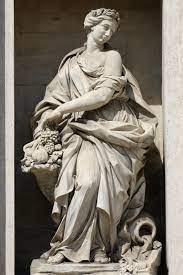
Photo: Detail of the statue of Abundance from Rome’s Trevi Fountain. Photo courtesy of Wikimedia Commons.
Last week, I cryptically noted that the late American comedian George Carlin and the concept of scarcity always come to mind when I ponder the question of why academic writing is so hard. Those of you who have been sitting on the edge of your respective seats, eagerly awaiting an explanation, can relax: said explanation is immediately forthcoming.
If you’re familiar with George Carlin’s work, you’ll no doubt recognize the line that comes to mind when I think about the difficulty of academic writing. Indeed, the line may have crossed your own mind at some point since last week:
“It’s a big club, and you ain’t in it.”
While Carlin used this phrase as a way of describing the exclusive in-crowd of well-known federal U.S. politicians, the sentiment can be applied to any institution or cultural practice whose inner workings are carefully guarded from the general public. Such institutions and cultural practices are both grounded in and sustained by the second of those seemingly random concepts that comes to mind when I ponder the question of why academic writing is so hard. That concept, you may recall, is the concept of scarcity. More accurately, that concept is the concept of artificial scarcity.
Actual scarcity and artificial scarcity play a key role in ensuring that exclusive institutions or cultural practices remain exclusive. Think about diamonds, for example. If diamonds were not so hard to come by (actual scarcity), they would lose much, or perhaps even all, of their perceived value. Or think about Jaguar cars. If Jaguar cars were not so hard to come by (artificial scarcity), they, too, would lose much, or perhaps even all, of their perceived value. For an example of scarcity in the realm of the nonmaterial, think of George Carlin’s U.S. politicians. Think of well-known federal politicians who spend mind-boggling amounts of money on their campaigns, not of an obscure town council person who spent a couple of bucks running off posters at the local copy shop, then biked or walked around the neighborhood with the family and a stapler, attaching said posters to utility poles. If
well-known federal politicians could become well-known federal politicians by simply running off campaign posters and stapling them to utility poles of a Saturday afternoon, well-known federal politicians would almost certainly lose the prestige that holds them squarely in the center of an elite bubble of exclusivity. The largely insurmountable expense of running for federal political office creates an artificial scarcity of opportunity to run for office; in turn, the artificial scarcity of opportunity to run for federal political office ensures that U.S. federal politics remains an exclusive institution. In other words, U.S. federal politics and the well-known players who can afford to act within the realm of politics remain a big club that most of us ain’t in.
Writing in general, and academic writing in particular, works in much the same way. The secrets of writing are carefully guarded—sometimes intentionally, sometimes not—by the folks who are already in the club of “people who know how to write.” In turn, the artificial scarcity of opportunity to learn the secrets of writing ensures that the group of people who know how to write remains a big club that lots of us ain’t in.
But things don’t have to be this way. Writing grows from the ideas in a writer’s heart or mind; writing is sparked by the ideas discovered in a book or film or conversation; writing springs forth from the wondrousness of a sunset or the tinyness of a birdsong; writing tiptoes out from the mundaneness of picking up the mail or washing the dishes. These things—ideas, books, conversations, birdsong, the banality of daily life—are by no means scarce. The words used to describe such things are by no means scarce. Nor are the endless permutations of syntax used to string words together scarce. Not one single thing about the act of writing is naturally scarce.
The artificial scarcity that upholds writing as an elite skillset is another matter, but it’s a matter that can be overcome in small, simple ways. The next time you hear a delightful birdsong, write a poem in your heart. You’ve just become a writer. The next time you go to the store, concoct a story featuring the items on your grocery list. You’ve just become a writer. The next time you post on Facebook or Twitter, you’ve reminded the world that you are a writer. The next time you read, take note of the words you especially love, and take note of the particularly elegant ways in which the writer strings words together. You’ve just given yourself tools to become a better writer. Bit by bit, the artificial scarcity of the writers’ skills vanishes, and you find yourself in, or at least very close to being in, the club. Someday, perhaps, the club will be so large that its secrets remain a secret no more.
In the meantime, tune in next week, when I’ll let you in on a secret for reading academic articles in ways that directly support you on your journey into the club.
Happy Writing!
Dr. Lori
 Engaging Texts: Has Your Text Been Engaged?